

Knee Cartilage
Demo Author One
Cartilage repair options for lasting joint health
A practical overview of cartilage repair, injection therapy, rehabilitation planning, and the clinical evidence that guides joint preservation care.

Injectable cartilage regeneration
Autologous Chondrogenic Injection
NanoACi regenerates worn cartilage using your own cells, without surgery. In one session Professor Paul Lee delivers three things from your own body, your cartilage cells, a ChondroFiller scaffold and PRF, by injection. It is his non-surgical evolution of the cartilage cell therapy family, ACI, MACI and STACI, performed for any joint.
 Reviewed byProfessor Paul Lee MBBch, FRCS (Tr & Orth), PhDCartilage and joint preservation expertise
NanoACi is an injection that regenerates cartilage using your own tissue. Professor Lee delivers your cartilage cells, a ChondroFiller scaffold and PRF into the joint in one thirty-minute session, with no surgery. It brings the cells-on-a-scaffold principle of ACI, MACI and STACI surgery out of the operating theatre and into an outpatient appointment. Regeneration made simple. Taking the surgical trauma out of surgery.
Verified across three networks
Where NanoACi sits
For thirty years the goal has been the same: use your own cartilage cells to rebuild a worn joint. Each generation has made the delivery better. NanoACi is the first to do it without surgery.

NanoACi treats a worn or damaged joint using three things your body responds to: living cartilage cells, a scaffold for them to build on, and the growth signals that help new tissue take. Professor Lee describes them as seed, soil and fertiliser.
Each of these is a known approach in its own right. The protocol, the way Professor Lee prepares and delivers all three in a single session, is what makes it NanoACi. It is, in effect, the cells-on-a-matrix idea behind MACI surgery, delivered by injection rather than open surgery. NanoACi is a technique he performs, not a product or device.
The three components
All three come from your own body, and Professor Lee delivers them together in one session.
A few tiny samples from your ear, processed chair-side into thousands of living micrografts using the Mytocel MSK technique.
A collagen matrix that gives the cells a structure to settle on and rebuild from, already used at the clinic for cartilage repair.
Platelet-rich fibrin, prepared from a small blood sample on the day, adds the growth signals that help new tissue take.
A single outpatient injection under local anaesthetic, start to finish in around thirty minutes. No general anaesthetic, no incision, no theatre.
The cells come from your own ear, the scaffold is placed in the same visit and the PRF is prepared from your own blood. Nothing foreign is introduced, so there is no rejection risk.
Used for the knee, hip, shoulder and ankle. There is no age limit; whether NanoACi suits your joint is decided on examination and imaging.
Everything happens in one appointment, using only your own tissue. Nothing is sent to a laboratory and nothing is grown over weeks.
Seed, soil and fertiliser, delivered in one session
Your cartilage cells
A few tiny samples from your ear are processed chair-side into thousands of living micrografts using the Mytocel MSK technique.
ChondroFiller scaffold
A collagen matrix that gives the cells a structure to settle on and rebuild from, already used at the clinic for cartilage repair.
PRF from your own blood
Platelet-rich fibrin, drawn from a small blood sample on the day, adds the growth signals that help new tissue take.
Professor Lee delivers all three into the joint in a single injection
Sequencing your own cells, scaffold and growth signals in one appointment is the NanoACi protocol. Nothing is sent to a laboratory and nothing is grown over weeks.
The cells are prepared with the Mytocel MSK technique, which breaks a small cartilage sample into micrografts of roughly eighty microns while keeping the cells and their surrounding matrix intact. That is what lets a treatment this powerful be delivered by a single injection.
It surprises most people, so it is worth explaining. The cartilage in your outer ear is a type called elastic cartilage, surrounded by a layer called the perichondrium that is rich in progenitor cells, the cells that can become new cartilage. Gram for gram, it holds more of this regenerative potential than the smooth cartilage inside a joint.
It is also easy to reach and quick to heal. Only three small samples of around 2.5 mm are taken, under local anaesthetic, from behind the ear where any mark is hidden. The same principle is already used in reconstructive surgery, where ear cartilage is valued for exactly these properties. Taking cells from the joint itself would mean disturbing the very surface you are trying to protect.
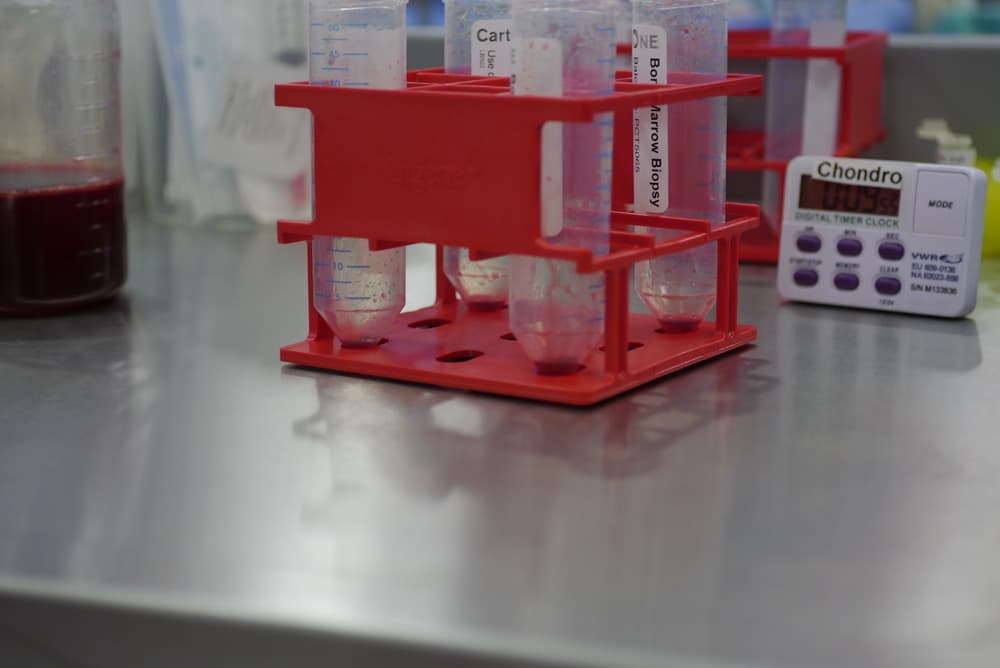
NanoACi is used across the range of cartilage wear and damage. The right option for your joint is set by examination and imaging, not from symptoms.
From early cartilage wear through to advanced, bone-on-bone joints, where the pattern of damage is reviewed on imaging.
Focal cartilage damage and softening, including chondromalacia patellae behind the kneecap.
Post-traumatic joint injury in active people, where early treatment may head off arthritis later.
NanoACi is offered for the knee, hip, shoulder and ankle. Which joints suit it best is confirmed at assessment.
2 to 6 weeks
Typical time to less pain and stiffness
One session
A single injection, not a course
Up to 3 years
Reported benefit from one treatment
These figures come from published studies of the auricular micrografting technology and of ChondroFiller. NanoACi is Professor Lee’s protocol for delivering them together, and he will explain what the evidence does and does not yet show for your particular joint. Cartilage cell therapy improves symptoms and joint function; long-term regrowth of new cartilage continues to be studied.
There is no age limit and no grade of wear that rules NanoACi out on its own. Imaging and a consultation with Professor Lee confirm whether it is right for you, and what to pair it with.
Been told your only option is a joint replacement? Bone-on-bone wear does not rule NanoACi out. Professor Lee will set out the honest options, which may include NanoACi with Arthrosamid or a replacement review. That is what an assessment is for.
NanoACi brings together approaches that each have their own published research. The auricular micrografting technology behind the Mytocel MSK step has been studied in knee osteoarthritis by Marcarelli and colleagues (a three-year follow-up), by Tsoukas and colleagues (a prospective observational study) and by Helito and colleagues (a clinical pilot). ChondroFiller, the scaffold, has its own body of evidence for supporting cartilage repair.
NanoACi is Professor Lee’s protocol for delivering them together in a single session. As with any newer combination, the honest position is that the strongest evidence sits with each component, and outcomes for the pairing are reported case by case. Professor Lee will walk you through what applies to your joint at consultation. See the full NanoACi evidence page.
The micrografting technology behind the Mytocel MSK step has been used in over 450,000 procedures worldwide across medical fields and is supported by more than 80 scientific publications. Those figures describe the technology’s wider track record, not London Cartilage Clinic’s own case numbers.
Pricing
£8,000, or £8,500 all-inclusive at London Cartilage Clinic. an MRI scan, your consultation, the NanoACi session and one follow-up
You may have more options than you think
At London Cartilage Clinic we follow a structured clinical framework across four areas of treatment. Before recommending a single procedure, we assess which combination of approaches gives you the best outcome.
Protect what you have. Slow degeneration and manage symptoms.
Fix specific damage. Torn tissue, unstable joints, structural problems.
Rebuild lost tissue. Biological treatments that stimulate new growth.
When other options are exhausted. Joint replacement as a last resort.
This treatment can be applied across multiple joints. Select yours to see the full range of options we offer, organised by clinical approach.
Explore All Treatment Options
NanoACi is an injection protocol for cartilage regeneration, invented by Professor Paul Lee. In a single outpatient session he delivers three things that come from your own body: your cartilage cells (prepared from a small ear sample using the Mytocel MSK technique), a ChondroFiller collagen scaffold, and PRF from your own blood. It is the non-surgical member of the cartilage cell therapy family that also includes ACI, MACI and STACI.
An injection. There is no general anaesthetic, no incision and no theatre stay. The whole appointment takes around thirty minutes under local anaesthetic, and most people return to light daily activity the same day. That is the main practical difference from STACI, which delivers a similar biology through keyhole surgery.
No. NanoACi is a technique, an injection protocol that Professor Lee performs, not a product or device. He prepares and delivers your own cells, scaffold and PRF in a defined sequence in one session. Each component is used in its own right; the protocol is the way he brings them together for your joint.
The cartilage in your outer ear is rich in cells with a high capacity to regenerate, held in a layer called the perichondrium. Only three samples of around 2.5 mm are needed, taken under local anaesthetic from behind the ear where any mark is hidden. The ear is simply the best accessible source of these particular cells; the treatment itself works in your joint.
ChondroFiller is the scaffold, the soil that gives your own cells a structure to rebuild on. NanoACi adds the cells themselves, as your ear micrografts, and PRF as the growth signal, so the scaffold arrives together with the tissue that builds on it. ChondroFiller alone is the simpler, lower-cost option; NanoACi is the fuller protocol.
Both deliver your own cartilage cells on a scaffold. STACI does it surgically, in theatre, and suits a focal, full-thickness defect in a joint worth a single-stage operation. NanoACi does it by injection, in clinic. They are complementary lanes, and Professor Lee advises which fits your joint after reviewing your imaging. See the full STACI page or the NanoACi vs STACI comparison.
Not necessarily. Advanced, bone-on-bone wear is not a bar to NanoACi. In that situation Professor Lee will usually discuss NanoACi together with an Arthrosamid injection to cushion the joint, or a joint replacement review, and explain the honest trade-offs of each. What suits you is decided on examination and imaging, not from symptoms alone.
Most people notice less pain and stiffness between two and six weeks after treatment. In studies of the auricular micrografting technology behind the Mytocel MSK step, benefit has been reported to last at least three years from a single session. Individual results vary with the joint, the extent of wear and your general health.
NanoACi is £8,000, or £8,500 all-inclusive, which covers an MRI scan, your consultation, the NanoACi session and a follow-up. Booking your MRI and appointment together is the simplest way to start. See the NanoACi cost page.
Still have more specific concerns?
Free Discovery CallExplore NanoACi
The full picture: who it suits, the evidence, recovery, cost, and how it compares with the alternatives.
Options that our doctors may discuss include NanoACi, ChondroFiller, Mytocel MSK, joint replacement, established conservative care or surgery, depending on examination and imaging.
Had an MRI in the last six months? Bring it to a consultation with Professor Lee. If not, the simplest way to start is to book your MRI and appointment together, so your imaging is ready when you are seen. A free fifteen-minute discovery call can point you the right way first.
London Cartilage Clinic
Clinical updates, cartilage treatment guidance, and recovery-focused articles from our specialist team.
A practical overview of cartilage repair, injection therapy, rehabilitation planning, and the clinical evidence that guides joint preservation care.
A practical overview of cartilage repair, injection therapy, rehabilitation planning, and the clinical evidence that guides joint preservation care.
A practical overview of cartilage repair, injection therapy, rehabilitation planning, and the clinical evidence that guides joint preservation care.